
Security & Scams
Crypto Taxes in Brazil 2026: MP 1303 Died — the Rules That Actually Apply
MP 1303 expired without becoming law, so the 17.5% flat crypto tax never took effect. Here is what actually applies in Brazil in 2026 — the R$35k monthly exemption, the offshore law, the new DeCripto report — and what Binance users need to do right now.
If you trade crypto in Brazil, two things matter more than anything else you will read this month. First: MP 1.303/2025 — the provisional measure that would have created a flat 17.5% tax on crypto gains — expired without ever becoming law, which means the "17.5% rule" still quoted in countless older articles simply does not exist. Second, and far more urgent: the first monthly DeCripto report is due in August 2026. The new filing, created by Normative Instruction RFB 2.291/2025, requires individuals — starting July 1, 2026 — to self-report monthly activity above R$35,000 on foreign exchanges, DEXs, and P2P. If July was a busy month on your Binance account, you may have a brand-new obligation to meet within weeks.
This guide lays out what actually applies in 2026, based on the measure's official status in the National Congress and on Receita Federal (Brazil's federal tax authority) rules, and ends with a practical checklist for Binance users. All facts were verified on July 27, 2026.
TL;DR
- There is no 17.5% flat crypto tax in 2026. MP 1.303/2025 lapsed on October 8, 2025 without a final vote; its official congressional status is "Sem eficácia" (without effect). Any article claiming otherwise is outdated.
- The R$35,000 monthly exemption still stands for sales on Brazilian exchanges and domestic P2P (the national capital-gains regime).
- Domestic track: gains above the exemption are taxed at progressive rates of 15% to 22.5%, computed monthly in GCAP and paid via DARF code 4600.
- Foreign exchanges (Binance international): under Law 14.754/2023 (the "offshore law"), gains are treated as foreign financial investments — a flat 15%, settled annually in the income tax return, with no R$35k monthly exemption.
- DeCripto: IN RFB 2.291/2025 replaced IN 1888/2019. Since July 1, 2026, individuals moving more than R$35,000/month on foreign exchanges, DEXs, or P2P must file monthly via e-CAC. The first filing is due in August 2026.
- Holdings: crypto with an acquisition cost of R$5,000 or more must be declared under Assets and Rights (Bens e Direitos), Group 08.
What happened to MP 1303 (and why so many articles get it wrong)
Provisional Measure 1.303/2025 proposed a broad overhaul of how financial investments are taxed in Brazil, including a single 17.5% rate on crypto gains (the joint committee's version even floated 18%). It dominated headlines through 2025 — and that is precisely where today's confusion comes from.
Here is how it ended. On October 8, 2025 — the final day of the measure's constitutional validity period — Brazil's Chamber of Deputies voted 251 to 193 to pull the MP from the voting agenda. With no vote on the merits before the deadline, the measure lapsed ("caducou"). In the National Congress system, its official status is "Sem eficácia" — without effect. You can verify this yourself on the MP 1.303 page at the National Congress.
The practical consequence: none of the MP's crypto provisions ever took effect. Not the 17.5% rate, not the committee's 18%, not the end of the monthly exemption it envisaged. What governs 2026 is the framework that existed before the MP — plus one genuinely new reporting obligation (DeCripto, covered below). If you read somewhere that "every crypto sale pays 17.5% in 2026," discard the source: it is out of date.
The rules that actually apply in 2026: two tracks
The point most people miss: your tax treatment depends on where you trade. There are two distinct tracks.
Track 1 — Brazilian exchanges and domestic P2P (national regime)
The classic capital-gains regime applies:
- Exemption: if your total crypto sales in a calendar month (all disposals combined) stay at or below R$35,000, the gain is exempt. Note that the threshold is measured on the amount sold, not on the profit.
- Rates: above the threshold, the month's gain is taxed progressively — 15% up to R$5 million, 17.5% from R$5 to 10 million, 20% from R$10 to 30 million, and 22.5% beyond that.
- Computation and payment: monthly, in Receita Federal's GCAP program, with a DARF payment slip under code 4600 due by the last business day of the month following the sale.
- Crypto-to-crypto counts: swapping BTC for ETH, or any coin for a stablecoin, is a disposal ("alienação") and enters the calculation — even if no reais are involved.
- Losses: losses recorded in GCAP can offset gains in subsequent months, within the program's rules.
Track 2 — Foreign exchanges such as Binance international (Law 14.754/2023)
For users of Binance's international platform, or any exchange without a Brazilian legal entity, the prevailing interpretation is that Law 14.754/2023 — the "offshore law" — applies:
- Crypto held abroad is treated as a foreign financial investment.
- A flat 15% rate applies to income and gains.
- Settlement is annual, in the yearly income tax return (DAA/IRPF) — there is no monthly GCAP and no DARF 4600.
- There is no R$35,000 monthly exemption on this track: every gain, however small, goes into the annual tally.
- Losses may be offset against income from other foreign financial investments within the same calendar year.
A note of intellectual honesty: this classification comes from Receita Federal's Q&A guidance and the dominant reading among tax practitioners and specialized outlets (InfoMoney, among others). This framing was consolidated mainly through Receita Federal's own regulations and guidance (IN RFB 2.180/2024 and its Q&A) rather than through express, literal wording in the statute — and some points remain open to interpretation. For significant amounts, talk to an accountant or tax lawyer before settling on a strategy.
Quick comparison
| Brazilian exchange / domestic P2P | Foreign exchange (e.g., Binance international) | |
|---|---|---|
| Legal basis | National capital-gains regime | Law 14.754/2023 (offshore law) |
| R$35k monthly exemption | Yes | No |
| Rate | 15% to 22.5% (progressive) | Flat 15% |
| Computation | Monthly (GCAP) | Annual (DAA/IRPF) |
| Payment | DARF 4600 by the last business day of the following month | In the annual return |
| Crypto-to-crypto | A disposal; enters the monthly calculation | Enters the annual tally |
| Loss offsetting | Against gains in later months (GCAP) | Against other foreign investments, same year |
Whichever track you are on, holdings with an acquisition cost of R$5,000 or more must be declared in the annual return under Assets and Rights (Bens e Direitos), Group 08: code 01 for Bitcoin, 02 for altcoins, 03 for stablecoins.
DeCripto: the new obligation debuting right now
Here is 2026's genuinely new development — and the reason this article is being published now. IN RFB 2.291/2025 revoked the old IN 1888/2019 and created DeCripto, Receita Federal's new crypto-asset report, aligned with the OECD's CARF international standard. It has been in force since January 2026, and the part that directly affects individuals kicked in on July 1, 2026.
Who must file: individuals whose crypto operations on foreign exchanges, DEXs, or P2P exceed R$35,000 in total in a month. Activity conducted exclusively on Brazilian exchanges continues to be reported by the exchanges themselves — in that case, the user files nothing.
When and how: the report is monthly and individualized, submitted through the e-CAC portal. With the obligation in force since July 1, 2026, the first filing happens in August 2026, covering July's operations. If you moved more than R$35k on Binance international in July, your DeCripto debut is now.
Penalties: late filing draws a fine of R$100 per month; omissions or incorrect information draw a fine of 1.5% of the operation's value. Since fine amounts carry details and may be adjusted, always confirm against the instruction's own text — the official entry point is Receita Federal's crypto-assets page.
Note the key distinction: DeCripto is a reporting obligation, separate from the tax itself. You can owe a DeCripto filing even for a month in which you lost money — the trigger is volume moved, not profit.
A practical checklist for Binance users
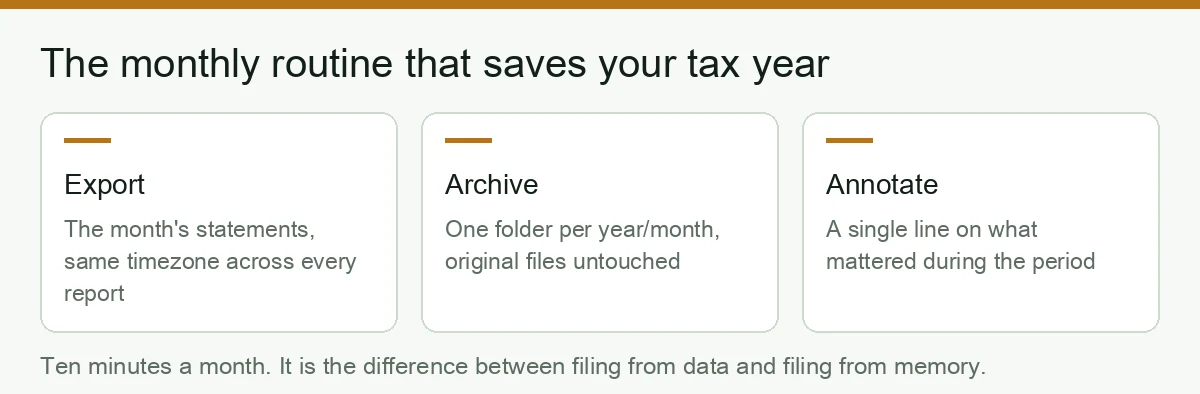
- Export and archive your statements every month. Trade, deposit, withdrawal, and conversion reports are the foundation of any tax computation — and of DeCripto.
- Keep the two tracks separate. Record foreign-platform activity (annual 15% rule) apart from Brazilian-exchange and domestic P2P activity (monthly regime with the R$35k exemption).
- Watch the R$35,000 monthly line. It appears twice: as the exemption ceiling on the domestic track, and as the DeCripto trigger for foreign-exchange, DEX, and P2P activity. A simple spreadsheet tracking the month's running volume is enough.
- Remember that crypto-to-crypto counts. Converting BTC to USDT is a disposal on the domestic track and adds to your volume for DeCripto purposes.
- Don't confuse fees with taxes. Trading fees reduce your result and feed into your cost basis — see our guide to Binance fees in Brazil.
- Declare your holdings. Acquisition cost of R$5,000 or more: Assets and Rights, Group 08, codes 01/02/03.
- Moving serious money? Hire an accountant. Especially on the foreign track, where the law leaves room for interpretation.
Frequently asked questions
Is the 17.5% flat rate in force in 2026? No. It was part of MP 1.303/2025, which lapsed on October 8, 2025 without becoming law (the Chamber voted 251–193 to pull it from the agenda on the last day of its constitutional deadline). Official status: "Sem eficácia." No flat rate ever took effect.
Is the R$35,000 monthly exemption gone? No — it remains valid in 2026 on the domestic track (sales on Brazilian exchanges and P2P within Brazil). What does not exist is a monthly exemption on the foreign-exchange track, which is governed by Law 14.754/2023.
Do crypto-to-crypto swaps trigger tax? On the domestic track, yes: a swap is a disposal and enters the month's calculation even without touching reais. On the foreign track, the result feeds the annual computation.
I just hold crypto and never sell. Do I need to declare it? If the acquisition cost is R$5,000 or more, yes — under Assets and Rights, Group 08. Declaring holdings triggers no tax by itself; tax applies only to gains.
Do I have to file DeCripto? Only if your operations on a foreign exchange, DEX, or P2P exceed R$35,000 in a month. Users who trade only on Brazilian exchanges are reported by the exchange itself.
Could the rules change again? Yes. The government has signaled interest in reviving parts of MP 1303 through other legislative routes. For now, the rules described here apply — keep an eye on official channels.
Important disclaimer
This article is for information only and does not constitute tax advice. Rules can change, and individual cases have specifics that no general guide covers. Where anything here diverges from official guidance, the rules and publications of Receita Federal and the National Congress prevail. Facts verified on July 27, 2026.
Risk warning: crypto assets are volatile and high risk; you can lose all of your capital. This content is educational and informational only and is not financial, legal or tax advice.
Regional notice: this site is aimed at readers in Brazil. It is not directed at residents of mainland China, the United States, the United Kingdom or Canada. Check and follow the rules in force where you live.