
Pix, Deposits & Withdrawals
Binance Withdrawal Fees: How to Know What You'll Pay
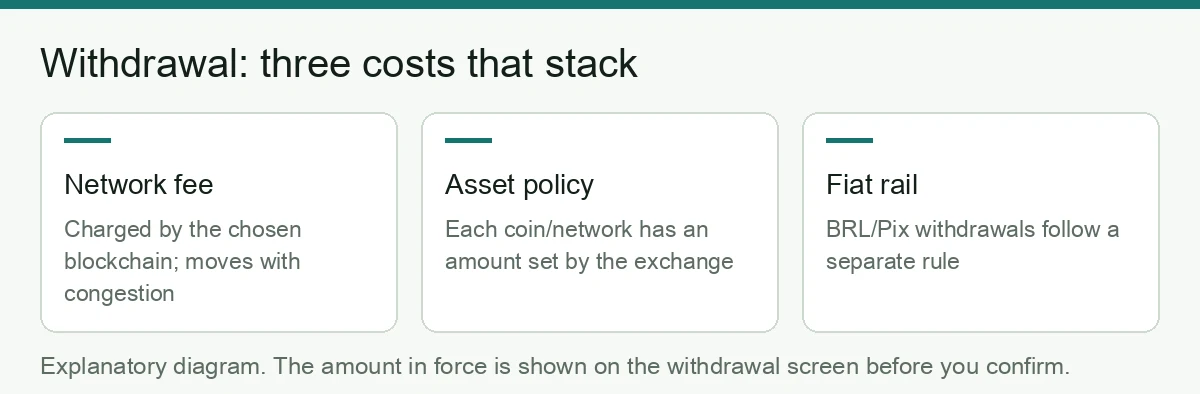
The withdrawal fee is not one number. It is the network you picked, the asset policy and the fiat rail — three different things on the same screen.
Search for "Binance withdrawal fee" and you want a number. That number does not exist as a fixed value: what it costs to move money out depends on what you withdraw, which network you choose and where it goes. Here is how the three parts work, and where to read the exact amount before you confirm.
1. Crypto withdrawals: the network sets the price
When you withdraw a coin you pick a network — TRC20, BEP20, ERC20, Polygon, Solana and so on. Each one has its own processing cost, and that cost dominates the total. The same USDT can be cheap on one network and expensive on another in the same minute, which is why the comparison is worth doing: cheapest network to send USDT.
Three things that catch beginners:
- The fee is usually fixed per withdrawal, not proportional to the amount. On a small transfer that fixed cost can eat a large share of the value; batching withdrawals lowers the relative cost.
- The destination must support that exact network. Sending on a network the receiving wallet does not accept is the most expensive mistake in crypto.
- Some assets require a memo or tag. Without that identifier funds can get stuck and need a recovery process.
2. BRL withdrawals via Pix: a separate rule
A fiat withdrawal does not follow the crypto table. It runs on the local payment rail, with its own rule, its own limits and the requirement that the destination account belongs to the same person who owns the exchange account. The amount in force appears on the withdrawal screen before you confirm — that screen, not a third-party table, is the source of truth.
3. The cost that is not labelled "fee"
Most people only look at the fee line and forget the rest of the route. To withdraw fiat you first had to sell crypto, and that sale had a cost: a trading fee on spot, an embedded spread on Convert, or a price gap on P2P. The full picture is in Binance fees in Brazil.
So the real cost of "taking X out of Binance" is conversion plus withdrawal. Comparing exchanges on the withdrawal fee alone produces wrong answers.
Where to read the exact amount
- Open the withdrawal screen for the asset you want.
- Select the network — the estimate updates the moment you switch it.
- Read the summary block: amount requested, fee, and amount that arrives.
- Only then confirm. If the arriving amount surprises you, go back to step 2.
That summary block reflects conditions at that moment. Any published table — including ours — ages.
How to pay less without taking on risk
- Batch your withdrawals. One larger withdrawal costs proportionally less than several small ones, within what makes sense for you and your account limits.
- Choose the network by destination first, price second. A cheap network the destination rejects costs you the whole amount.
- Consider not withdrawing at all. If the goal is just to swap assets inside the exchange, moving out and back is the most expensive path.
- Test before large amounts. Send the minimum, confirm arrival, then send the rest — see moving crypto to your own wallet.
Bottom line
"Binance withdrawal fee" is really three questions: which network, which asset, and which rail. The reliable answer lives on the withdrawal screen at the moment you transact — and the total only adds up when you include the conversion that came before it.
Affiliate disclosure: this article contains referral links. If you sign up to Binance (code BNB6669) through our links, you get a 20% trading-fee discount (under the programme's current terms) and this site earns an affiliate commission at no extra cost to you.
Risk warning: crypto assets are volatile and high risk; you can lose all of your capital. This content is educational and informational only and is not financial, legal or tax advice. Do your own research before trading.
Regional notice: this site is aimed at readers in Brazil. It is not directed at residents of mainland China, the United States, the United Kingdom or Canada. Check and follow the rules in force where you live.