
Pix, Deposits & Withdrawals
Cheapest Network to Send USDT in 2026: Compared
The same USDT transfer can cost cents or tens of dollars depending on the network. Compare TRC20, BEP20, ERC20 and the alternatives — and avoid the wrong-network trap.
Sending USDT from Binance to another wallet or exchange can cost anywhere from a few cents to tens of dollars — same amount, same destination, only the blockchain network changes. This guide compares the options in 2026 and shows how to choose without hitting the number-one risk: losing funds to a wrong-network transfer.
Why the same USDT lives on many networks
USDT is issued on dozens of blockchains (Ethereum, Tron, BNB Smart Chain, Polygon, Solana…). The token represents the same dollar, but each network has its own transaction fee, speed and compatibility. At withdrawal time Binance asks which network to use — and that's where most people either overpay or err.
The most-used networks compared
| Network | Typical fee | Speed | Notes |
|---|---|---|---|
| TRC20 (Tron) | Very low | Fast | The default choice for simple transfers |
| BEP20 (BNB Chain) | Very low | Fast | Widely supported |
| Polygon | Very low | Fast | Great when the destination supports it |
| Solana | Very low | Very fast | Growing support |
| ERC20 (Ethereum) | The most expensive | Variable | Can cost several dollars in congestion; required by many DeFi protocols |
Exact values move with network congestion and exchange policy — the current fee is shown on the withdrawal screen before you confirm. Treat the table as orders of magnitude, not fixed prices.
How to choose in 3 steps
- Check what the destination accepts. Open the deposit page of the target wallet/exchange and look at the networks listed for USDT. That list rules.
- Pick the cheapest network both sides share. Usually TRC20, BEP20 or Polygon.
- Double-check address and network. The address+network pair must match exactly. TRC20 addresses start with
T; BEP20/Polygon/ERC20 addresses all start with0x— that identical0xformat is exactly where people mix them up.
Sending on the wrong network can mean permanent loss. Some cases are recoverable with support help (slow, sometimes costly); others aren't. When in doubt, send a small test amount first — the extra fee is the cheapest insurance in crypto.
Tip: sometimes you don't need to withdraw at all
If you're just holding, keeping USDT in the account avoids the network fee — weighed against custody risk, of course. And transfers between two Binance accounts via e-mail/ID are usually free, touching no blockchain.
The full cost picture
The network fee is one line of your total cost. The complete map — trading, Pix, Convert, P2P — is in Binance fees in Brazil. Building the position first? Start with how to buy USDT with Pix in Brazil.
Before you pick: three checks that beat any fee table
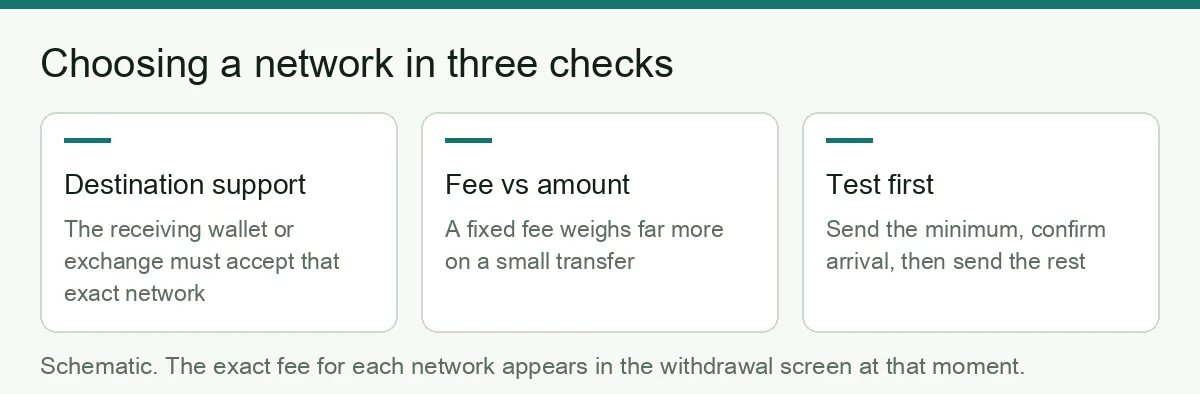
Fee tables age fast, and the numbers on a blog post are never the numbers on your withdrawal screen. What does not age is the decision process:
1. Does the destination support that exact network? This outranks price every single time. The same asset symbol on the wrong network is the most expensive mistake available to a beginner, and it usually cannot be undone by anyone. Check the receiving side first, then choose.
2. How does the fixed fee compare to your amount? Withdrawal fees are usually fixed per transaction, not proportional. That means a network which looks cheap in absolute terms can still be terrible for a small transfer, and a slightly pricier network can be irrelevant on a large one. Always think in percentage of the amount you are moving.
3. Have you tested it? Send the minimum, confirm it arrived, then send the rest. The cost of a test transfer is trivial next to the cost of discovering a mistake with the full balance.
Two situations where the "cheapest network" is the wrong question
- You do not actually need to withdraw. If the goal is swapping assets, doing it inside the exchange avoids the whole network question (Convert vs spot).
- Your destination only supports one network. Then there is no choice to optimise — there is only a check to perform before pressing send.
What the total cost really includes
The network fee is one line. The full cost of moving value out also includes whatever conversion you did before it, and — for fiat — the local payment rail at the end. That complete picture is in Binance fees in Brazil, and the withdrawal side alone is broken down in Binance withdrawal fees.
Affiliate disclosure: this article contains referral links. If you sign up for Binance (code BNB6669) through our links, you get a 20% discount on trading fees and this site earns an affiliate commission, at no extra cost to you.
Risk warning: cryptocurrencies are volatile, high-risk assets; you may lose your entire capital. This content is educational and informational only and does not constitute financial, legal or tax advice. Do your own research before trading.
Regional notice: this site is aimed at readers in Brazil. It is not directed at residents of mainland China, the United States, the United Kingdom or Canada. Check and comply with the regulations in force in your country.