
Comparisons & Fees
Binance Convert Spread: How to Measure the Real Cost
Convert has no fee line, but it does have a cost: the gap between the quoted price and the spot reference. Here is how to measure that gap yourself.
"Convert is fee-free" is both true and misleading. True, because there is no line labelled fee on the screen. Misleading, because there is a cost — it just lives somewhere else: in the quote. Here is how to measure it in under a minute, no spreadsheet needed.
Where the cost comes from
On Convert you are not trading against an order book; you accept a locked price valid for a few seconds. Whoever offers that price carries the risk of movement during that window — and charges for it by quoting slightly worse than the reference market. That gap is the embedded spread.
It is not a scam or a trick: it is the price of convenience and guaranteed execution. The only real problem is that people who never measure it assume they paid zero.
The calculation, step by step
- Open the Convert quote for the pair and the amount you actually intend to use. Size matters: quotes can change with it.
- Note the implied price. If the screen shows "you receive X", divide your input amount by X (or the reverse, depending on the pair) to get the unit price offered.
- Open the spot market for the same pair, in the same minute, and note the reference price.
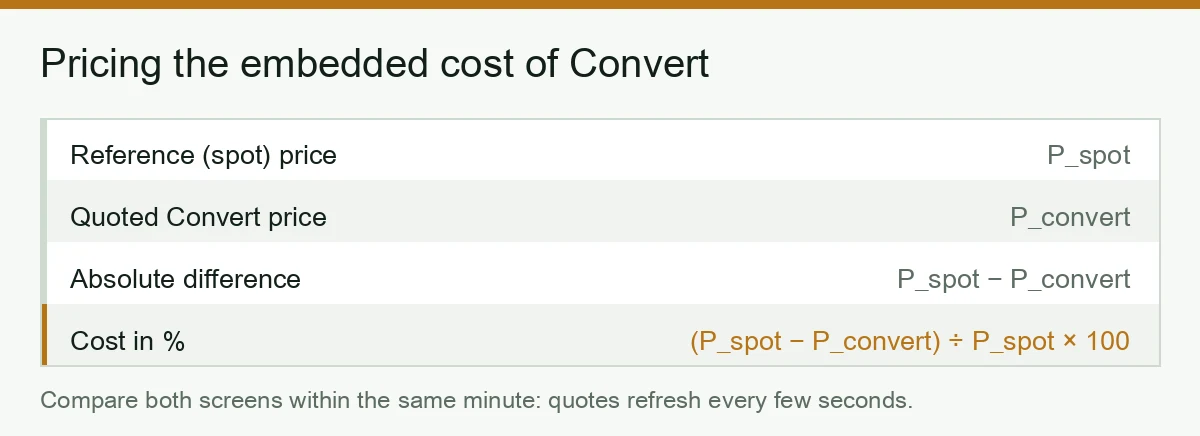
- Apply the formula: (reference price − quoted price) ÷ reference price × 100.
That result is the percentage cost of that conversion. Repeat it two or three times at different hours and you will see the spread is not constant — it tends to widen in volatile moments and in thinner pairs.
How to read the number you got
Compare that percentage with the total cost of the alternative route:
- Spot charges an explicit fee per order, but you choose the price and can trade as a maker. The direct comparison is in Binance Convert vs spot.
- P2P charges no fee to the buyer but builds margin into the ad price (comparison).
A rule of thumb that holds up: the larger the amount, the more it pays to spend two minutes on spot; the smaller and more urgent, the more Convert wins on convenience. Exactly where the crossover sits depends on your pair, your moment and the discounts active on your account.
When Convert is the right call
- Small amounts, where the percentage difference is cents and your time is worth more.
- Pairs that need multiple steps on spot, where you would place two orders and pay a fee twice.
- Dust and leftovers that would not even meet a spot order minimum (converting dust to BNB).
- When you cannot afford a fat-finger error. A locked price removes the risk of mistyping size into the book.
When it is not
- Large amounts, where tenths of a percent become real money.
- Very liquid pairs, where the book is deep and spot is competitive (how to read the order book).
- Repeated operations: a small cost multiplied by dozens of conversions stops being small.
Three mistakes when comparing
- Comparing at different minutes. The market moves; the gap you measured may be drift, not spread.
- Ignoring size. Quoting with a tiny amount and trading with a large one can give different answers.
- Forgetting the rest of the route. If you will withdraw afterwards, add the withdrawal fee; the sum is what decides.
Bottom line
Convert is neither cheap nor expensive by decree — it is convenient and measurable. Run the calculation once, with your pair and your size, and you stop deciding by slogan. The full cost map is in Binance fees in Brazil.
Affiliate disclosure: this article contains referral links. If you sign up to Binance (code BNB6669) through our links, you get a 20% trading-fee discount (under the programme's current terms) and this site earns an affiliate commission at no extra cost to you.
Risk warning: crypto assets are volatile and high risk; you can lose all of your capital. This content is educational and informational only and is not financial, legal or tax advice. Do your own research before trading.
Regional notice: this site is aimed at readers in Brazil. It is not directed at residents of mainland China, the United States, the United Kingdom or Canada. Check and follow the rules in force where you live.