
Getting Started
Maker vs Taker on Binance: Why Your Fee Changes
A maker adds liquidity to the book and pays less; a taker removes it and pays more. Understanding that is the cheapest way to cut your trading cost.
Two people buy the same asset, for the same amount, on the same day — and pay different fees. That is not a glitch: it is the difference between maker and taker. It is the fee concept that matters most for anyone who trades regularly, and the one least explained to beginners.
The order book in one sentence
Spot markets run on an order book: a list of who wants to buy at what price, and who wants to sell at what price. When the two sides meet, a trade happens. If that idea is new, start with how to read the order book.
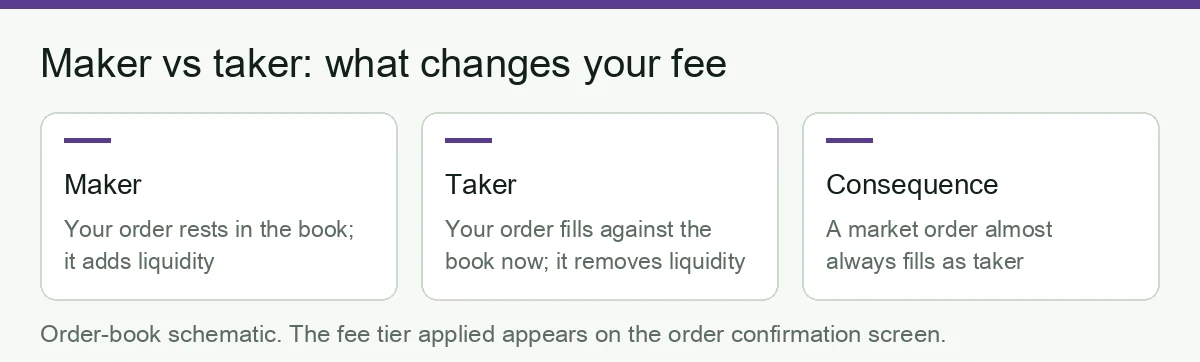
Maker: your order waits
You place a limit order at a price that does not exist in the market yet. It rests in the book, available for someone else to trade against. You added liquidity — you made the market deeper. The exchange rewards that with the lower fee tier.
The trade-off: your order may never fill. The price simply may not reach it.
Taker: your order fills now
You send a market order (or a limit order priced so that it crosses the book immediately). It consumes offers that were already there. You removed liquidity, so you pay the higher tier in exchange for instant execution.
In other words: you pay for urgency. That is a reasonable trade sometimes — but it should be a choice, not an accident.
The part almost nobody calculates
The gap between maker and taker tiers usually looks small. But there is a second cost that never appears in the table: a large market order "walks the book", filling at progressively worse prices until it completes. In liquid pairs that is negligible; in thin pairs it can cost more than the fee itself.
How to test it without theory: place a small market order and compare the average fill price with the price shown on screen beforehand. The difference is real, and you just measured it.
How to trade as a maker more often
- Default to limit orders. Set the price you accept instead of taking whatever the market imposes (order types explained).
- Place the order on the correct side. Buy below the current price, sell above. If it crosses the book, it fills as a taker.
- Accept non-execution. A price alert removes the urge to stare at charts (price alerts on Binance).
- Do not force it in thin pairs. Where the book is shallow, insisting on maker can cost more time than the saving justifies.
Discounts sit on top of this
The maker/taker tier is the starting point; the discounts active on your account apply on top of it — paying fees in BNB, a volume-based tier and a referral code. The three layers stack and are covered in Binance fee discounts. What the token itself does is in what is BNB.
Where to check what you actually paid
Trade history shows price, quantity and fee for every fill. It is the only source that reflects your account, with your discounts applied. Open it after your first few trades: most people are surprised by how many orders filled as taker without them meaning to.
Bottom line
Makers pay less because they wait; takers pay more because they are in a hurry. Swapping the market-order habit for limit orders is the cheapest cost improvement available — it needs no volume, no tier and no programme. The full cost map is in Binance fees in Brazil.
Affiliate disclosure: this article contains referral links. If you sign up to Binance (code BNB6669) through our links, you get a 20% trading-fee discount (under the programme's current terms) and this site earns an affiliate commission at no extra cost to you.
Risk warning: crypto assets are volatile and high risk; you can lose all of your capital. This content is educational and informational only and is not financial, legal or tax advice. Do your own research before trading.
Regional notice: this site is aimed at readers in Brazil. It is not directed at residents of mainland China, the United States, the United Kingdom or Canada. Check and follow the rules in force where you live.